
Newsletter # 2
The Contrarian Approach to Three Trends Changing the Business World
In my first ever ‘Scott’s Thoughts’ newsletter, which you can find here, I wrote about the Top Three Megatrends that I believe are reshaping the world at large, and more specifically, reshaping the business world for salespeople, sales leaders, and entrepreneurs...
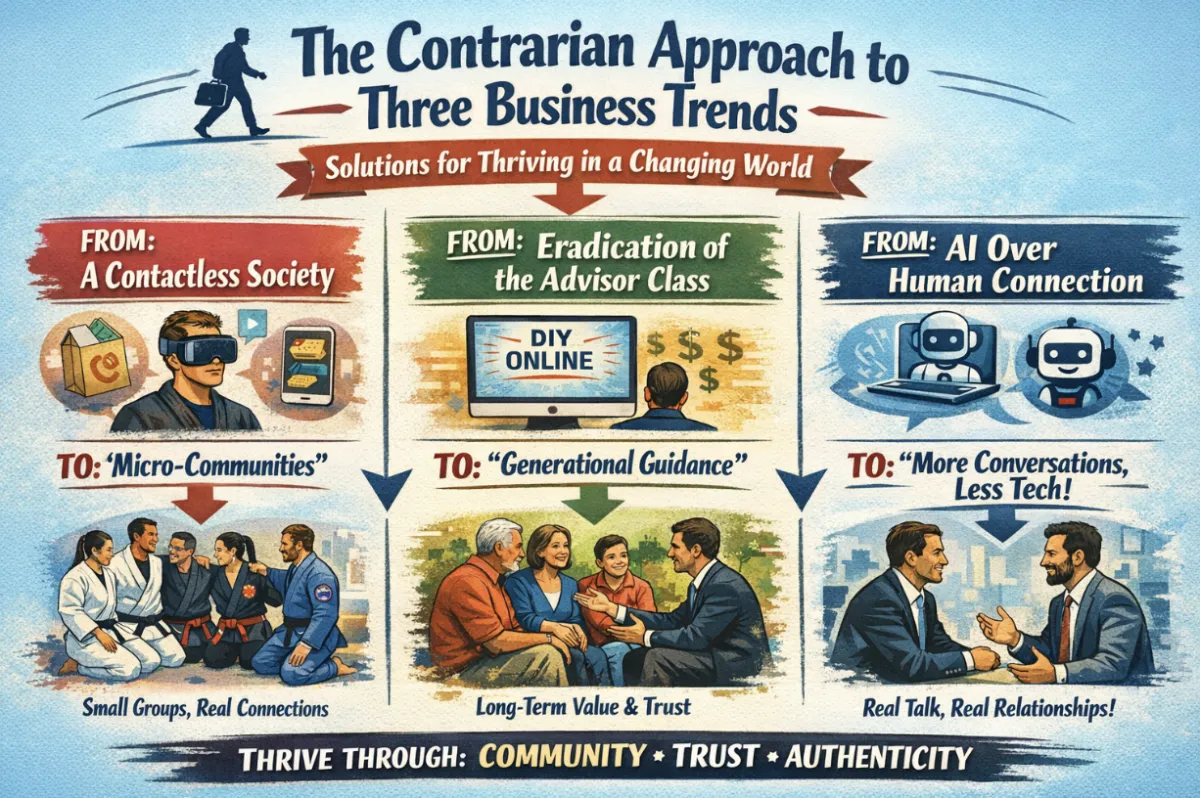
More specifically, I spoke about how we are being negatively impacted by:
A Move Towards a Contactless Society
The Eradication of the Advisor Class
Artificial Intelligence Over Human Connection
If you didn’t have a chance to read that newsletter - I would encourage you to go back and read that first issue.
My first newsletter may have left you a bit depressed. Maybe you connected with the way I was expressing some of the problems I outlined, but was hoping for some solutions.
The good news is that today we’re going to explore some solutions to what I believe are systemic problems facing sales professionals, sales leaders, entrepreneurs, and maybe even society at-large…
I want to begin with an approach I have been using in my life, and with my coaching clients, that has been remarkably effective at addressing one of the negative trends we explored in our last issue. And that is….
#1 - Micro-Communities’, The Solution to a Contactless Society
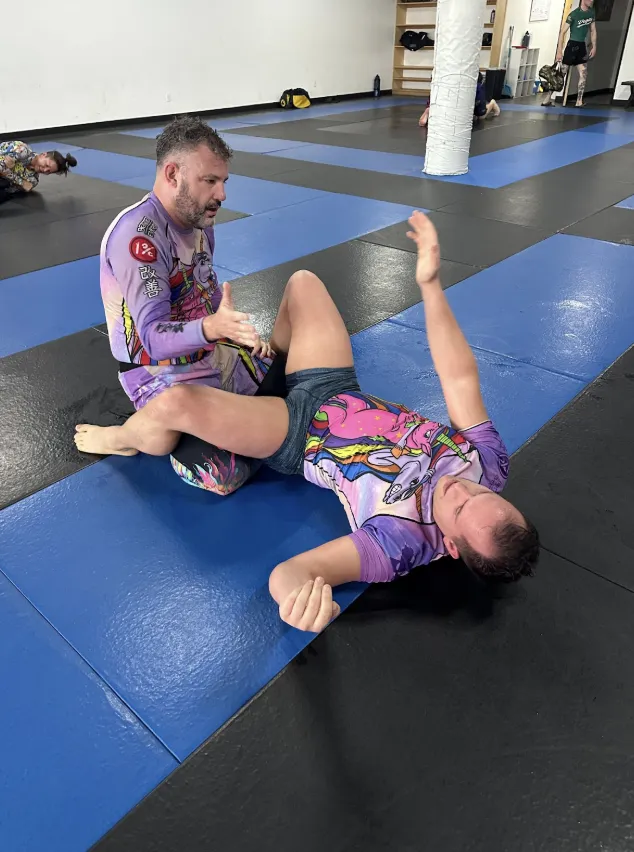
This is a photo of my friend Brenton and me doing Brazilian Jiu-Jitsu. This photo was taken just seconds before we were about to lay on top of each other, attempting to choke each other unconscious, and exchange an ample amount of bodily fluids (in the form of sweat.. get your mind out of the gutter).
And yes… because we are both characters, and don’t take ourselves too seriously, we are both wearing a sweat-wicking rash-guard kit covered in rainbow unicorns!
There’s nothing funnier than two grown men, engaging in a ‘combat sport,’ wearing skin-tight shirts sporting a rainbow unicorn.
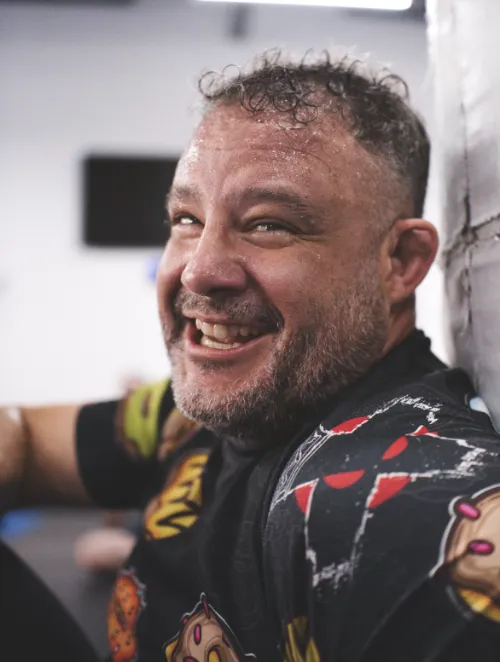
BTW, in case we’ve never met before, I’m the guy on my knees. And yes, the picture at the top of the newsletter is me, mid workout at jiu-jitsu, with a donut patterned rash-guard on! Luckily for me, and sadly for Brenton, I’m still a better grappler than he is! I tend to get on top, stay on top, and make his life generally miserable every morning at 6am. I hope he reads this newsletter and has a rough day knowing that I’m talking about him 🙂
So what does this have to do with with the business problem I outlined for you in newsletter #1? If you recall, I explained that the biggest companies of our generation are being built on the premise that human interaction is no longer a FEATURE of doing business, it’s a BUG!
Peloton - Why waste time working out with other humans… when you can workout from the comfort of your own bedroom, pedaling for miles in a stationary position?
Door Dash - Why be bothered with the person sitting next to you who might crunch their ice too loud, and risk having a conversation with a stranger… when you can just order food right to your doorstep?
Netflix & Paramount+ - Why risk going to a crowded movie theater, interacting with a neighbor, or having to browse the TV to find something interesting… when you can be spoonfeed a diet of shows that exactly fit your predetermined preferences?
Coursera - Why learn from a professor, mentor, or elder and risk hearing the same story for the 14th time… when you can have information on demand 24/7, from someone you’ll never meet and have a real conversation with.
Don’t get me wrong, in many ways I love the conveniences of modern technology.
AND, not BUT, AND… I think humans still crave human interaction. I know that I do. I get depressed when I go a day or two without seeing a friendly face.
It’s still important to be able to interact with strangers. I love when my daughter compliments a barista or store-clerk, and that person lights up from receiving some kind words from a child.
It’s still beneficial to MEET new people in scenarios that will never happen from the comfort of your own home!
Who knows, in the olden days, this is how people even found new friends and made business connections… or, heaven forbid…got married. Gasp!
And this brings me to my solution… creating 'Micro-Communities!’
So what IS a 'Micro-Community', exactly? Well, I tend to define 'Micro-Communities' along the lines of ‘Dunbar’s Number.’ If you’re not familiar, Dunbar’s number comes from the concept of the correlations between the brain size of primates, and the size of the social circle we can keep clear in our mind.
Paraphrased from wikipedia:
“Dunbar's number is a suggested cognitive limit to the number of people with whom one can maintain stable social relationships. This number was first proposed in the 1990s by Robin Dunbar, a British anthropologist who found a correlation between primate brain size and average social group size. By using the average human brain size and extrapolating from the results of primates, he proposed that humans can comfortably maintain 150 stable relationships.”
This graph illustrates the theory:
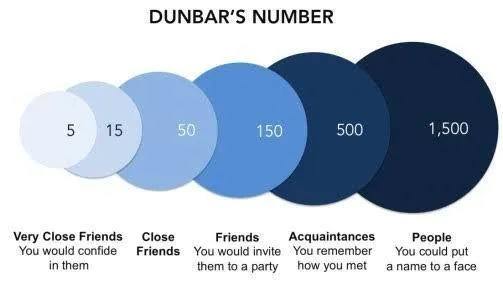
So for me, I consider a 'Micro-Community' to be a group of friends, a social circle, or common place of attendance that has anywhere from five to fifty consistent participants.
When I look back on the successes I’ve had in my life, and take inventory of the things that brought me joy & made me money - I think of Dunbar’s number. It’s been the same for my coaching clients, and probably the same for you. There is almost always a component of being part of a 'Micro-Community' that made these parts of my life a personal or professional success.
If you think about it, I’m guessing you have several similar examples in your life!
Got Healthier… that was thanks to a 'Micro-Community' of fellow gym-goers, and later jiu-jitsu practitioners, who held me accountable so I would continue to show up!
Top Producer in The Mortgage Industry… that was due to a 'Micro-Community' of referral partners I built, wherein we knew we could trust each other to get the deals closed!
Built a Coaching Business From the Ground-up… that was due to starting with a 'Micro-Community' of professionals where I brought knowledge, and we worked together to turn that knowledge into insights on how coaching clients could grow their businesses.
Opened a School (yes, my wife and I own a school)... that stemmed from finding a 'Micro-Community' of parents who weren’t happy with the schooling options in our area, and presenting them an alternative.
Needed Support in My Marriage… Front Row Dads, a mastermind community I’m part of (that you’ll likely hear more about in an upcoming newsletter), is a 'Micro-Community' of Fathers who are business owners, not business owners trying to make time to be a father.
My point is this… humans need human interaction.
Whether it’s by design, by choice, or by societal pressure; if you’ve entered the paradigm shift of living in a ‘contactless society,’ I suggest you make some changes.
Find a 'Micro-Community'. Build a 'Micro-Community'. Pay to be part of a 'Micro-Community!’ Despite what Facebook, Amazon, and Netflix want us to believe… Humans need HUMAN contact. Preferably in-person. Preferably for several hours a day.
You might be asking yourself, is this just a nice way to live life, based on Scott’s ‘feelings?’
NO, 'Micro-Communities' is how business professionals thrive instead of just survive.
Need a referral...
Need an introduction...
Need some additional support…
‘Micro-Communities’ can help. My guess is that, intrinsically, you already know this. When you need help & support you probably lean on small communities of family, friends, & like-minded business professionals who you already know and have a relationship with!
Is business slow? You probably go to a ‘Micro-Community’ of referral sources and top clients to help drum-up new leads.
This takes us to the solution to the second of our negative trends, explored in issue one, which is…
#2 - Generational, Not Relational - The Solution for the Eradication of Advisors
A story that has been making the rounds for most of my adult life has been the cautionary tale of the Travel Agent.
The demise of the travel agent actually started well before the proliferation of the internet and the introduction of sites like Travelocity and Kayak.
It actually started in 1995 when the airlines capped the commissions that travel agents could make to $50 per round trip ticket.
It appears that passengers, while comparing flight costs with fellow travelers, were disgruntled with what appeared to be huge variances of price for the same flight. This cap on commissions earned by travel agents started the collapse of the industry.
In 1997, and again 1999, the government (assisted by airlines and travel destinations) capped the commission that travel agents could make off of bundled trips. In two years commissions dropped from 10% of trip cost down to 5%. These were the jabs that set-up the knockout punch.
Then in late 1999 came the devastating, Mike Tyson upper-cut, with the expansion & adoption of E-commerce on the internet.

In the year 2000, about 6% of all travel was booked online, directly by consumers. By 2005 that number had soared to 29%.
By 2020, the last reliable data that I could find, travel that is booked online directly by consumers was hovering just above 80%. In two decades we saw consumer behavior change, and travel agencies imploded.
So how do financial planners, tax-professionals, mortgage loan officers, real-estate agents, and other sales professionals ensure that they don’t suffer the same fate? How do you stake your claim to continuing to be a valuable advisor who consumers are willing to pay for?
Let me start by sharing a meme that went viral in the mortgage & real-estate industry a few months ago.
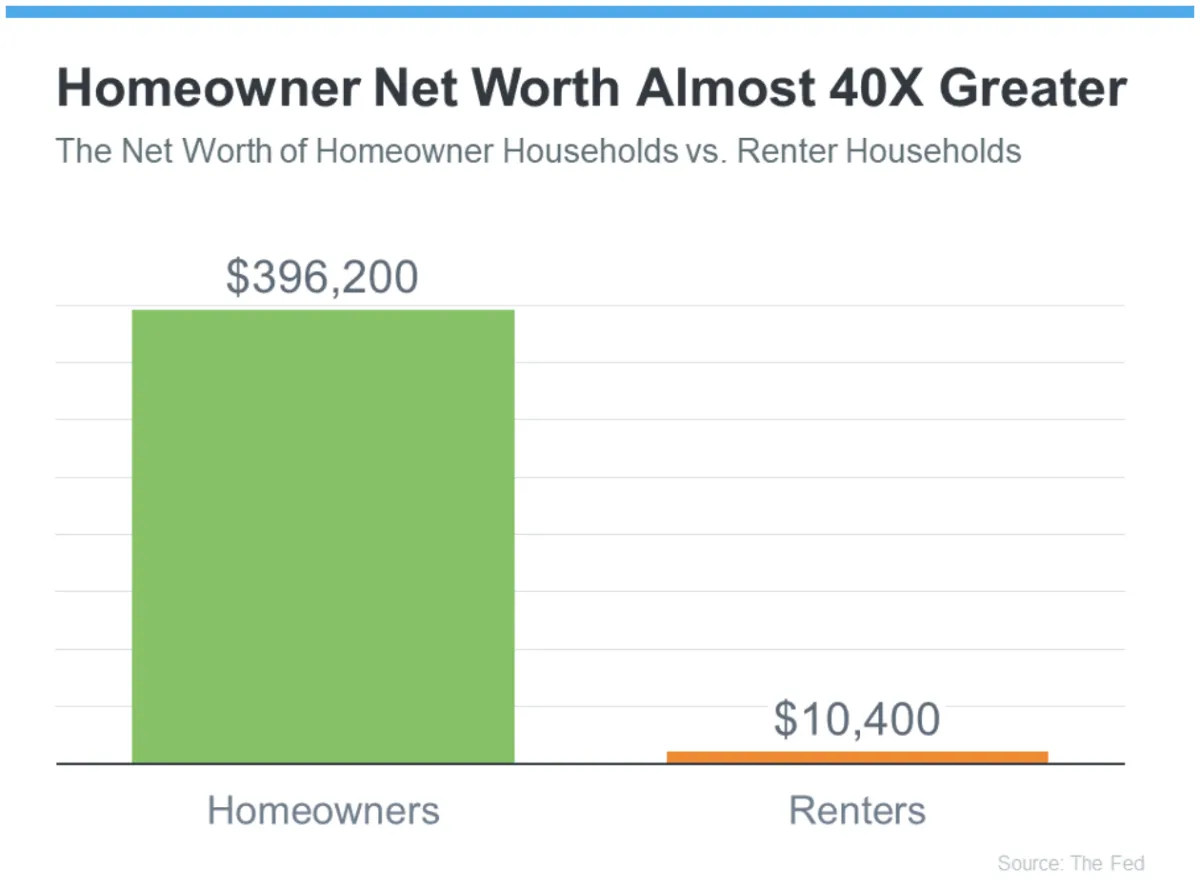
Realtors & Loan Officers were using this graph to show that homeowners, on average, are 40x’s wealthier than renters. Not 40 percent richer, 40 TIMES RICHER! Every Realtor & Lender that I’m friends with on Facebook was sharing some version of this information, to point out that the industry in which they work is creating generational wealth for their clients.
BUT, they forgot to connect the dots! They forgot to explain to the consumer why this data MAKES the advisor, the Realtor, the loan officer IMPORTANT to the process of purchasing a home.
You see, most Loan Officers & Realtors have fallen into the trap of trying to replace human connection, real education, and valuable advice, with technology.
I’ve used this line before, and it offends some people, but I’m going to say it anyway. If you act like a prostitute, you’re going to get treated like a prostitute.
Meaning that, if all you bring to the process is a transactional relationship… DO NOT be surprised when someone searches out a cheaper option with less friction.
A real life example of this is the time it takes a loan officer to start a mortgage application for a new client.
If you are meeting a new client, chatting for two minutes, and then sending them to an online application portal to fill out their own application and upload their own documents…
What human value and/or knowledge are you bringing to the process?
Why wouldn’t you expect that consumer to seek out a cheaper deal, work with an online provider, and/or just go to ChatGPT to find ‘better’ answers?
Conversely, in my coaching program we teach Loan Officers, Realtors, and Financial Planners to turn that initial conversation into what we call a ‘Dreams & Goals’ call.
This should take 25-30 minutes where you go deeper, on the initial call, to talk about the client’s long term goals, aspirations, generational plans, expenses & obligations that don’t show up on a credit report, etc.
You see, if we believe our own hype, if we are helping people make generational decisions, then spending an extra 20-30 minutes on an upfront ‘get to know ya call’ is no extra time at all.
In the context of generational planning, 30 minutes is a rounding error!
When advisors approach relationships, conversations, and interactions with a generational mindset, they add value in a way that stands out.
In a market where FinTech companies just want you to move quickly through their online portal and click the next button as fast as possible, be the human who delivers real knowledge and real value!
We will dive deeper into this concept in a future newsletter. So just keep this in mind: When you approach your businesses with a generational mindset, there is a substantially lower chance you will get replaced by a ‘bot!’
Which takes us to…
#3 - More Conversations, Fewer ‘Tools’ - A Solution to the Changing Business Landscape
To be clear, I’m not ‘anti’ Artificial-Intelligence.
I’m not ‘anti’ technology.
As a matter of fact, right after I finish this newsletter, I’m going to be prepping for a workshop that I’m conducting for Loan Officers & Realtors on the ‘Basics of AI & ChatGPT!’
I use AI on a daily basis as a research tool, as a thought partner, and to make fun graphics.
Here’s one that my son made when we were trying to come up with characters for a book he wants to write:

BTW… turns out that my 9-year-old son, Gabe, describes comic book characters in the same way that his dad would! Whoops!
But here’s the problem. Your average sales-professional, sales-leader, and entrepreneur has been sold the wrong bag of goodies. They’ve been sold the wrong solution.
The answer is NOT:
❌ More tech, more tech, and even more tech!
❌ More tools & subscription services!
❌ A CRM that does just one more thing than the last CRM. Which did one more thing than the CRM before that. Which had just a little bit more functionality than the CRM before that!
❌ More automation, more robo-calls, more dialers, more virtual assistants to make your sales calls, more team-members to hand your sales process off to!
❌ More online leads. More funnels. More Facebook ads!
Yes, technology, even AI, has its place in making business more efficient.
YES, the sales professional who integrates tech appropriately is going to replace the sales professional who doesn’t integrate tech.
However, tech, and especially the overuse of AI, is not the answer.
We have started to see the cracks. We have already seen the online backlash against AI-created social media and sales copy.
People need to be able to trust their own eyes.
They need to trust that what they believe to be real, is actually real! They need to have their intuition and their spidey-sense reaffirmed in order to stay grounded in reality and feel connected to business professionals they are working with.
The simple solution to the changing business landscape is: MORE MEANINGFUL CONVERSATIONS, FEWER TOOLS
✅ More phone calls, fewer spammy emails!
✅ More human connection throughout the sales cycle!
✅ More EDUCATION & Advising
✅ More AUTHENTICITY
✅ Fewer touch points & more TRUST points!
✅ And lastly, contrary to what you’ve been told, more face-to-face meetings!
Again, we will dive in deeper to this idea of conversations that matter, and how to have more of them, in a future newsletter. I have a formula that works for sales professionals called “80% Curiosity, 20% Courage!” But this could take up another 2,000 words… so we will get to that.
For now, just know that ‘Micro-Communities,’ a generational mindset, and conversations over tools is a great way to start thinking about solving some of the problems your business is facing.
My Invitation to you is this: If you’re feeling any of these forces I’ve described above at work, or like any of my solutions, HIT REPLY to this email, and give me your thoughts.
I personally read each and every response. Hearing from you would not only mean the world to me, but it would also help me shape the upcoming issues of this newsletter. And as a bonus, I will be doing my best to individually respond to each email I receive to this brand new “Scott’s Thoughts” newsletter!
P.S. - once again I didn’t have 10,000 hours to become a graphic designer, so AI did make the picture below!
Till the next time I have 2 hours to think,
Scott :-)
© Scott's Thoughts. 2026. All Rights Reserved.