
Newsletter # 5
Atoms Versus Electrons
Published on: April 12, 2026
Why Atoms Are More Important Than Electrons!
Why are ‘atoms’ more important than ‘electrons’? The following thoughts are from a recent conversation I had with a Senior DevOps Engineer, Claude-coder extraordinaire, and good friend of mine, Mike Lady.
Here’s Mike, who is also one of my jiu-jitsu coaches, trying to teach me something on the mat! Spoiler alert: I’m not helping him up he’s about to pull me into a triangle and choke me out with his legs.
At this moment, I was understanding this jiu-jitsu move about as well as I understood the beginning of our conversation on atoms versus electrons.

For those of you who don’t remember high-school chemistry, or didn’t major in electrical engineering in college like my buddy Mike, let’s quickly define these terms.
ATOMS - An atom is the smallest, fundamental unit of ordinary matter that retains the chemical properties of an element. Atoms are incredibly small, make up all physical substances, and consist of three main subatomic particles: protons (positive) and neutrons (no charge) in the nucleus, surrounded by electrons (negative).
AKA, atoms are the building blocks of everything we see & touch.
ELECTRONS - An electron is a stable, negatively charged elementary subatomic particle that orbits the nucleus of an atom. As a fundamental constituent of matter, it is not composed of smaller particles and carries a charge. As I remember from high school, electrons are the part of the atom that move around a lot and effectively create a negative electric charge… I think.
For this conversation, let’s just know that electrons are the building blocks of technology. Every electrical system, microchip, and computer fundamentally operates on the flow and control of electrons.
*** And yes, for the nerds who read my newsletter, I know that electrons are part of atoms, but I think you’ll get where I’m going here in a moment.
I’m going to use these terms to categorize the difference between us humans, who are atoms, versus computers & technology, which are electrons. My friend, author, and brilliant thinker Christopher Lochhead, more about him in a future newsletter, describes this a different way when comparing our current societal dynamics.
He classifies people into two categories, ‘Analog Natives,’ versus those of us who are ‘Digital Natives!’
He argues that most people over 40 years of age are ‘Analog’ or ‘in-real-life’ first, while many Americans under 40 are ‘digital natives,’ or value their ‘on-line life’ more!
As I discussed in Newsletter #3, ‘How to Combat a Contactless Society’ I talked about how technology companies are making the push to make the human experience, and in-person connection, a BUG, and not a FEATURE.
Especially when it comes to sales jobs, the financial services industry, and the push towards digital-first FinTech companies, we humans are just so last century.
Human interaction, meeting face-to-face, being out in public, interacting with prospects in person, and doing sales training in person are frequently frowned upon in the current business environment in which we find ourselves.
I wholeheartedly disagree with this thesis. But many sales professionals, and the companies they work for, have fallen for this trap. I call it the…
“SaaS Trap”
The exponential rise in enterprise value of Software-as-a-Service (SaaS) businesses over the last few decades has, sadly, distorted the strategic focus of sales professionals, sales leaders, and the companies they work for.
Consequently, many companies, like the ones I’ve worked for in the mortgage, real-estate, and financial planning industries, have felt compelled to try and replicate this high-valuation SaaS model. Sales organizations that have traditionally relied on ‘atoms,’ that human connection, great customer service, & long-term relationships, have pushed towards a more ‘digital-first’ business model!
The desire to try to replicate the success of SaaS companies is rooted in an understandable frustration! Consider a bank or mortgage company.
These are organizations instrumental in helping millions of clients accomplish major life goals like homeownership and financial independence, while managing thousands of employees and complying with extensive government regulations.
And…
This same company is valued at less than a software company that allows you to schedule TikTok posts or manage your OnlyFans account!!! I can see how that would be infuriating for business leaders, and create some desire to move your business from atoms (personal connections) to electrons (more and more digital connections & processes).
Thinking from the perspective of a company that sells financial services, why invest time and money into personal relationships, face-to-face meetings, and humans… when the big winners in business are the companies who have turned everything into an online portal, often with no way to even talk to a human!
Trust me, get locked out of your Facebook, Google account, or CRM, and let me know how long it takes you to get a human involved to try to fix the problem!
But recently, there are major cracks in the foundation of these SaaS companies, and I believe we sales professionals need to start reevaluating how we do business. Many of these SaaS companies are having a moment of financial reckoning due to..
Two Guys on a Beach in Bali

Back to my conversation with Mike Lady, the software developer.
He was explaining to me that there is a saying going around the tech-bro-world called ‘The Two Guys in Bali Dilemma.’
Meaning that if two guys, sitting on the beach in Bali with a couple laptops and a few Mai-Tais, can replicate your business from their computer, you DO NOT HAVE a business. Investors and the ‘the stock market’ knows this.
Year-to-date, software-as-a-service businesses have shed about one TRILLION dollars in value.
In a one week period last month, these SaaS companies lost about $300,000,000,000 of market value; yes, that’s $300B, billion with a B, dollars in market cap & stock price decline in a few days.
You should go back and read that. ONE-TRILLION dollars of stock losses amongst the top 300-400 companies that deliver software via a recurring-revenue business models.
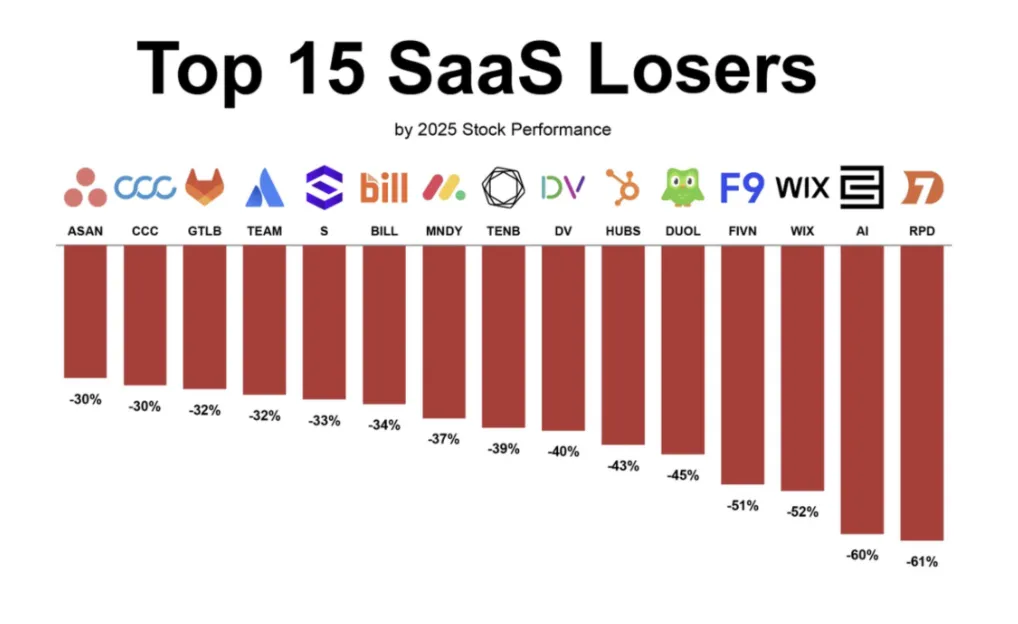
For context, here is a list of a few COUNTRIES whose entire gross domestic product (GDP), meaning the entire economic output of the country, is under one trillion dollars: Turkey, Switzerland, Taiwan, Poland, Sweden, Belgium, Argentina, Norway, Israel, UAE!
The reason for this is simple. AI is creating an environment where two guys on a beach in Bali can rebuild these legacy tech companies in a few weeks while on vacation.
Why would you or your company pay $250 a month, per person, for a CRM that can be rebuilt in ChatGPT for pennies?
Why would you pay $100 a month for a social media scheduling tool, when Claude can do it for you?
Why would you pay any subscription service of any kind, if it can be replicated cheaper and be more customizable with AI?
If a new SaaS company does strike gold with a specific software or service that adds tremendous value to our business, you and I can replicate that exact product with Claude-Code for a few hundred bucks in under a week.
So for the salesperson, financial company, or CEO who just read this and is rightfully scared that our industry might be next, what’s the solution?
Human Interaction is the ‘MOAT’ Around Your Business
As I’ve been ruminating on these thoughts above for a few years now, I was excited to see that ‘Gary V’ is finally coming around to my way of thinking :-)
If you don't know Gary V, he's basically the guy who coined the term ‘day-trader of attention.’
He's made a fortune by being an early adopter on trends like e-commerce, YouTube, TikTok, and NFTs, so he definitely knows where the market is headed and what future trends look like.
In a recent viral post, which he shared across all the social platforms, including business platforms like LinkedIn, he declared that ‘Analog’ will make a HUGE comeback over the next five years! You can check out that YouTube short here!
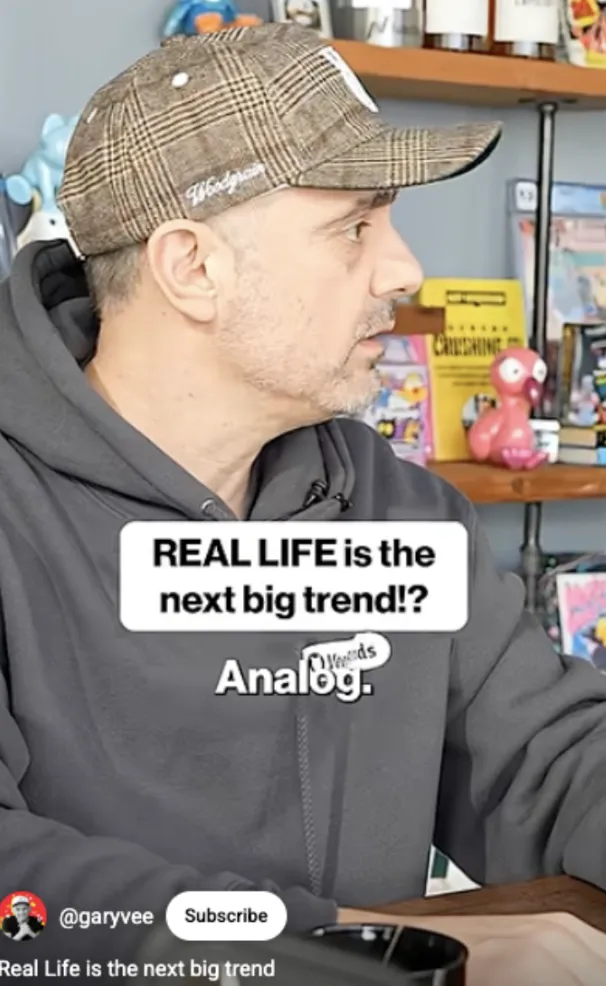
What Gary V was specifically talking about in this short was that ‘Analog,’ AKA in-person, live events are about to be the hottest new trend. Entertainment venues, meet-ups, dinner parties, phone-free events, these are likely going to be the next big consumer boom.
The fact that getting together in person is some type of hip, new idea for younger generations… kind of melts my 47-year-old brain… but whatever, at least they are doing it!
I also think Gary’s thoughts about consumer behavior over the next 5 years extend into our business world as well. These are things I’m observing from my coaching clients, their referral sources, and business owners who employ salespeople:
Salespeople & our clients are going stir-crazy working from home!
Everyone is Zoom’d out!
No one wants another team-building exercise on Slack!
No client wants another online portal, application site, or upload portal they are forced to do business with, unless it comes with human context and education!
No one wants yet another app on their phone where they have to monitor more digital communication!
Sales professionals, and the people they sell to, are hungry for in-person interactions where my atoms can hug your atoms (or at least shake hands).
Very few people are hungry for more digital interaction, social media connection, AI slop videos, AI robo-dialers, or voice-texts where I pass my electrons over to your electrons.
And that brings us to the final concept in our newsletter. If you, yes you, the sales professional, sales leader, or CEO of a large sales organization (yes, I know who my readers are), have over-indexed for, or solely focused on “Electrons” instead of “Atoms,” your business is in for a rude awakening.
To build your ‘moat,’ you have to focus a little bit less on tech, and a little bit more on people!
In a business context, a ‘moat’ is simply the natural barrier or guardian around your castle (or, in this example, your business).
For nearly 30 years, companies in competitive sales industries have tried to create a moat around their business model by improving their flow of electrons and investing in more tech.
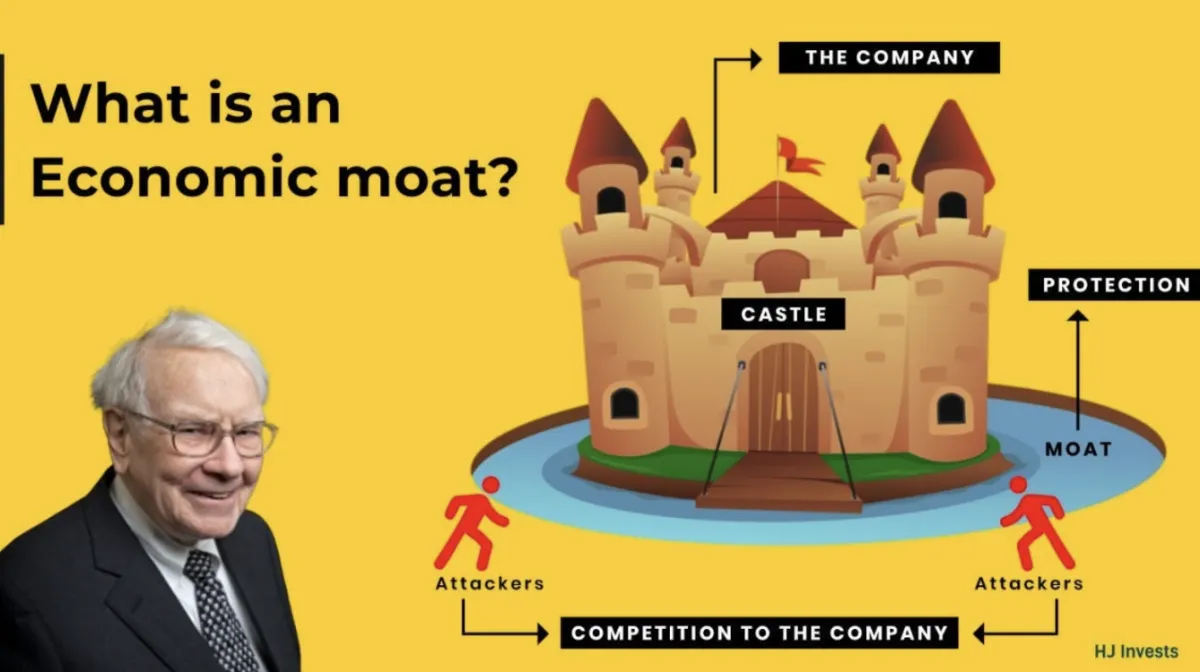
I believe that the companies who thrive over the next decade will be the companies who invest in improving their ‘atoms,’ AKA their PEOPLE. Upleveling their sales team, reinvesting in human interaction with their referral sources, and adding personalized education & context to their client-facing tech stack! This will become the differentiator and the ‘moat’ around their business model.
In my next newsletter, I will explain how we can use the human experience, personal interactions, and face-to-face education to create a protective 'moat' for companies, with your referral sources, and with your clients. So stay tuned!
By the way, if you’re a SERIOUS techie, you can subscribe to my buddy Mike Lady’s “Enterprise Vibe Code Newsletter” here: https://www.enterprisevibecode.com/
Don’t forget to share this newsletter with someone who might be interested, and connect with me on social media if you want to see the changes I’m making in 2026. If you got forwarded this email, you can subscribe at www.ScottsThoughts.com
My invitation to you is this: If you’re feeling a bit disconnected from humans right now, or feel like you and/or your company have over-indexed on technology and electrons, HIT REPLY to this email, and give me your thoughts.
I personally read each and every response. Hearing from you would not only mean the world to me, but it would also help me shape the upcoming issues of this newsletter. And as a bonus, I will be doing my best to individually respond to each email I receive for this brand new “Scott’s Thoughts” newsletter!
Till the next time I have 2 hours to think,
Scott :-)
P.S. None of this was written by AI, my assistant, or a ghost writer. Just me, a real person who probably made a few typos in the newsletter above. The picture of the two guys on Bali with their laptop was AI-generated. Please forgive me!
© Scott's Thoughts. 2026. All Rights Reserved.